est. 1995
Athens Institute
A World Association of Academics and Researchers: Promoting Global Education & Research
1995-2025: 30 Years of Bringing Academics and Scholars together in Athens
From Haiti in 1804 to 20th Century Decolonization:
Insights from the Event on the Emergence of Nation-States
With strong scientific and comparative interest, the Athens Institute held an event on Monday, March 30, 2026, on the theme of “Revolutions of National Independence and the Birth of the Nation-State during the 18th and 19th Centuries“, under the auspices of the Athenian Academic Periodical.
The event was moderated by Lambros Ap. Pyrgiotis.
A common thread across the presentations was that the transition from empires to the modern world of nation-states was not a linear process, but rather the outcome of wars, ideologies, institutional transformations, and international interventions. Particular emphasis was placed on transatlantic revolutionary influences.
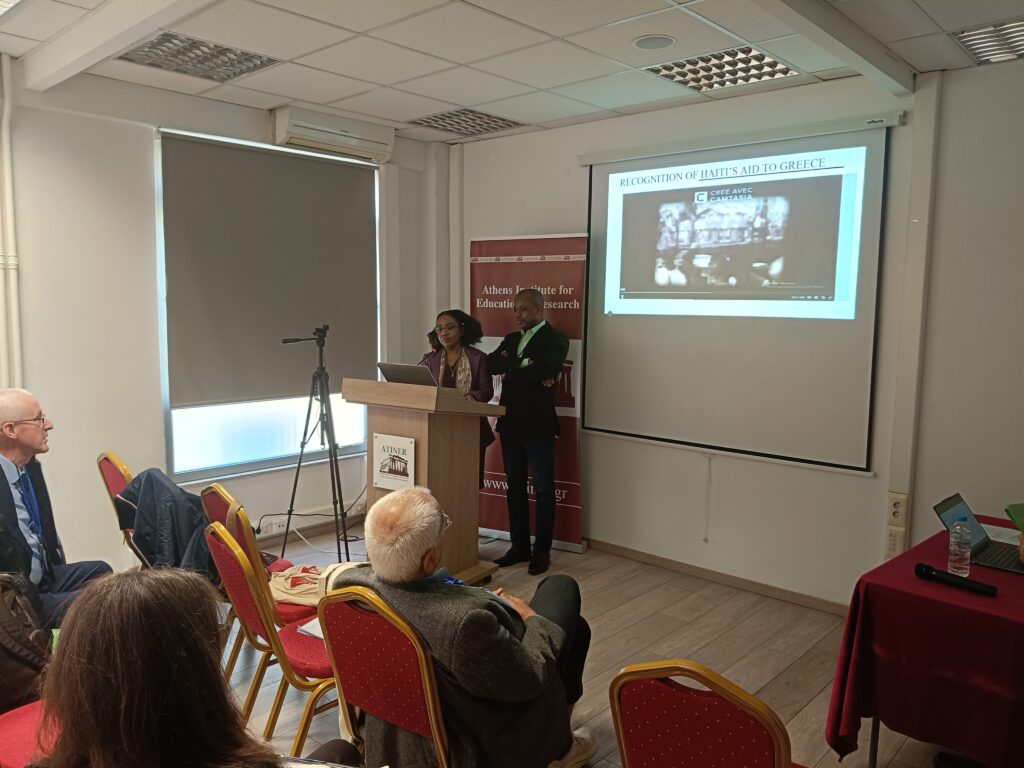
A key contribution was the analysis by Oubriyan Damus (Professor, State University of Haiti, Haiti & Visiting Professor, University of Sherbrooke, Canada), who highlighted Haiti—the first “Black” republic—as a catalyst for global revolutionary developments. Its independence in 1804 was not only a historic break from colonialism and slavery, but also an active force supporting other national struggles—including the Greek War of Independence in 1822—thus effectively transforming human rights into a universal value.
Raquel de Caria Patricio (Associate Professor, University of Lisbon, Portugal) examined transformations in the Portuguese-speaking world, focusing on the transfer of the Portuguese royal court to Brazil in 1808, an event that accelerated the transition from colonial administration to independence and the formation of a nation-state.
Pedro Ricardo Fonseca (Professor, Guarda Polytechnic University & Researcher, University of Coimbra, Portugal) emphasized Portugal’s long historical path toward the modern nation-state, noting the continuity of administrative centralization from monarchy to the constitutional era. However, it was the liberal ideas circulating in the Atlantic world that inspired military officers and urban elites to demand constitutional reform through the Liberal Revolution of 1820, leading to the establishment of national sovereignty in 1822.
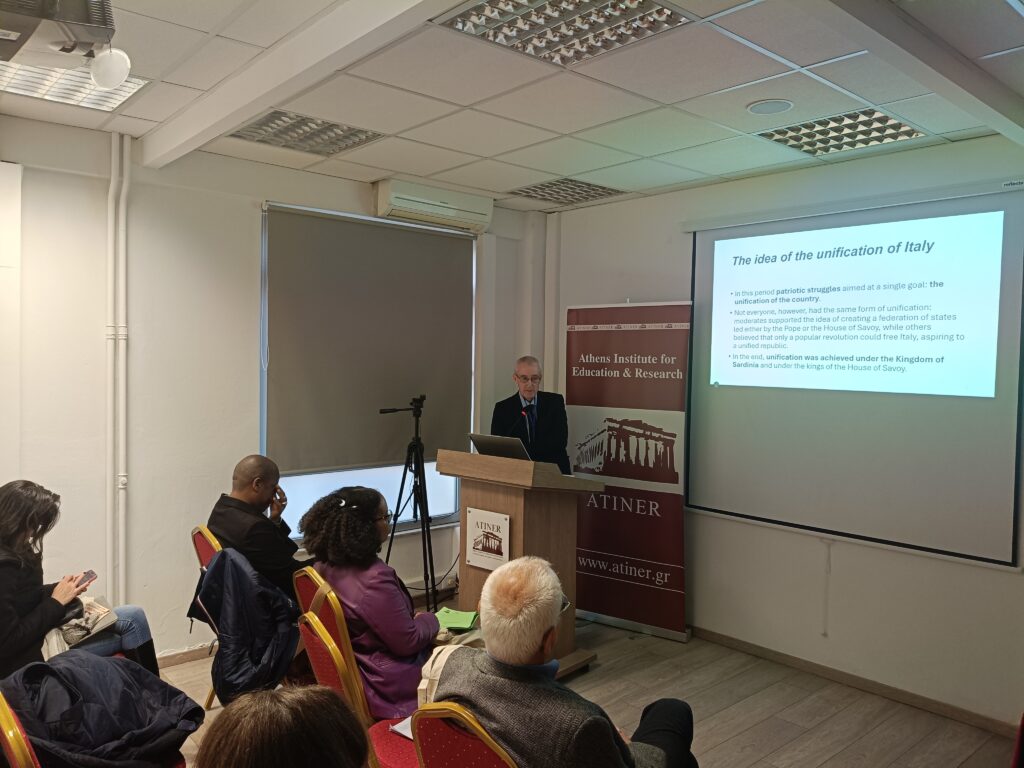
In the European context, Stefano Maggi (Professor and Chairman, University of Siena, Italy) revisited the discussion on Italian unification, highlighting a frequently underestimated factor: technological infrastructure. As he demonstrated, railways were not merely a technological achievement, but a crucial instrument of war and national integration, enabling military mobilization and accelerating political developments, thus confirming the link between the Industrial Revolution and political movements.
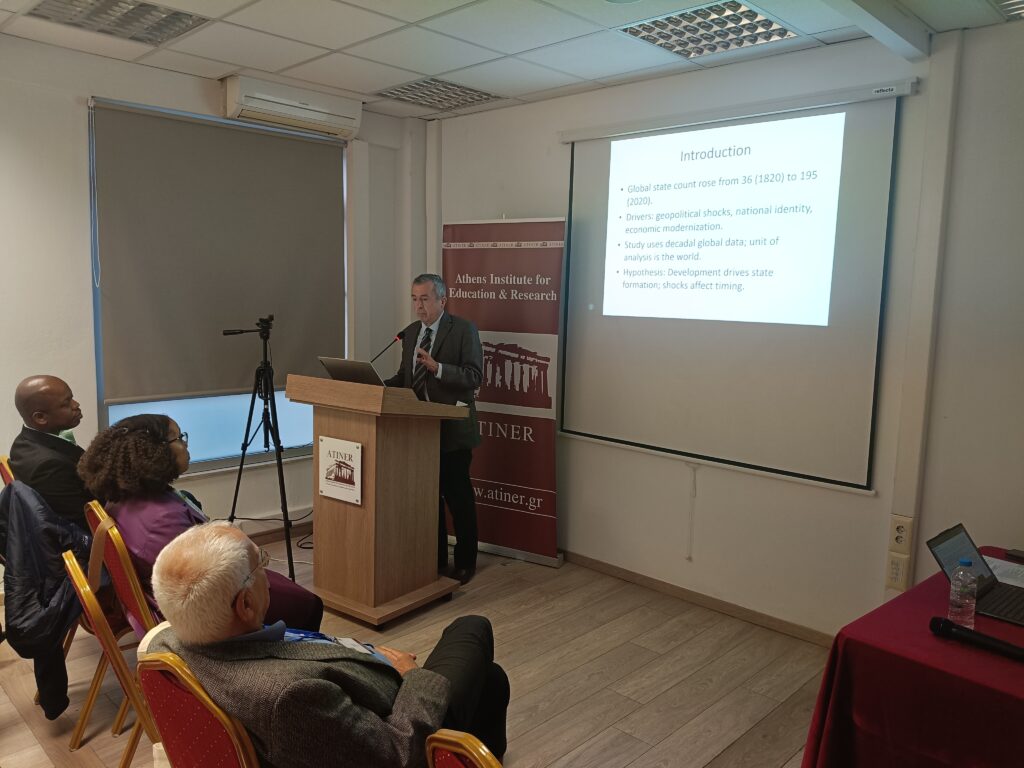
Finally, Gregory T. Papanikos (President, Athens Institute & Professor (Adjunct), University of Tennessee, Knoxville, USA) presented an analysis of the long-term evolution of sovereign states from 1820 to 2020. It was emphasized that the remarkable expansion of the international system—especially following the decolonization period after World War II—is closely linked to both economic and social development as well as large-scale political transformations.
The event concluded with an active discussion with the audience, confirming that, despite increasing globalization, the issues of state sovereignty and national identity remain highly relevant today.